
9September 2026
What’s the Hardest Furniture to Assemble? A Mississauga Handyman’s Honest Take
If you’ve ever stared at a box full of flat-pack furniture and wondered whether you’re in for a quick afternoon project or a weekend-consuming headache, you’re not alone. As a residential handyman in Mississauga who’s assembled everything from basic nightstands to full PAX wardrobe systems, I can tell you this: the hardest furniture to assemble isn’t always the biggest, most expensive, or most complicated-looking piece. It’s the furniture where poor instructions, misaligned holes, or unforgiving hardware turn a simple job into a frustrating marathon.
In this post, I’ll break down the pieces that consistently eat up the most time, share a real-life case study, explain the top pain points I see on every difficult assembly, and give you my personal “difficulty rating” system to help you decide when to DIY and when to call a pro.
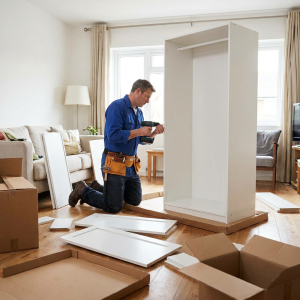
The 3 Types of Furniture That Consistently Give Homeowners Trouble
From my experience working in Mississauga homes, these three categories of furniture are the ones that most often turn into time-consuming, precision-heavy jobs.
IKEA PAX Wardrobe Systems
PAX units can be straightforward when you’re assembling one basic frame. But larger combinations with multiple frames, doors, drawers, and interior organizers can become a full-day job. The biggest issue is alignment. The frames need to be perfectly square and level, especially when installing sliding or hinged doors. A floor that’s slightly uneven, which is common in many Mississauga homes, can make the final adjustment surprisingly time-consuming.
IKEA MALM Dressers and Bed Frames
MALM furniture isn’t necessarily difficult because of the number of parts. It’s the repetitive hardware and precision required. There are lots of similar-looking pieces, and if one panel is installed backwards or a cam lock isn’t seated correctly, you can end up partially disassembling the unit to fix it. With larger MALM dressers, I also take extra care with the wall-anchoring requirement because stability is just as important as getting the drawers working properly.
Wayfair Oversized Beds and Upholstered Bedroom Furniture
Some of the most time-consuming pieces I’ve encountered through Wayfair have been large upholstered beds, storage beds, and platform beds with drawers. The difficulty varies by manufacturer, but I’ve seen situations where pre-drilled holes don’t line up perfectly, threaded inserts aren’t seated correctly, or the hardware bags aren’t clearly organized. Storage beds are particularly frustrating because there can be a surprising number of rails, brackets, slats, and moving parts.
The common thread with all three isn’t simply “bad furniture.” It’s quality control plus precision plus instructions. A professional can usually work around those problems, but homeowners often underestimate how much time is lost when you have to stop, figure out which piece is wrong, correct an alignment problem, or undo several previous steps.
My rule in Mississauga is simple: if the furniture has multiple moving parts, drawers or doors that must align perfectly, wall anchoring, or a complicated modular design, I price it based on the actual complexity rather than assuming it’s just another flat-pack assembly. That’s where the difference between a quick two-hour assembly and a frustrating half-day job usually comes from.
A Real-Life Case Study: When a “Simple” Wardrobe Turned Into a Half-Day Job
One job that stands out was a large IKEA PAX wardrobe system for a homeowner in Mississauga. The homeowner had expected it to be a fairly straightforward assembly, basically a few hours with the boxes laid out and the instructions followed step by step.
The problem was that it was a larger configuration with multiple wardrobe frames, drawers, shelves, and doors. Once we started putting everything together, we discovered that the floor wasn’t perfectly level. That doesn’t sound like a major issue, but with a tall wardrobe system, even a small amount of unevenness can create alignment problems. The doors weren’t sitting correctly, and some of the drawer fronts needed adjustment.
Rather than forcing the hardware or trying to compensate by tightening everything unevenly, I went back through the installation, checked the individual frames for square, levelled the base properly, and then worked through the door and drawer adjustments. We also made sure the unit was properly secured to the wall rather than treating the anchoring as an optional final step.
What the homeowner learned was that furniture assembly isn’t always just about putting pieces A, B, and C together. The condition of the room, particularly the floor and wall, can affect the finished product. A large modular wardrobe can look simple on the box but require quite a bit of precision once it’s installed.
Since that job, I tell Mississauga homeowners upfront: if you’re assembling a large wardrobe, storage bed, entertainment unit, or other tall piece of furniture, allow extra time for levelling, alignment, adjustments, and anchoring. If everything goes perfectly, great, you finish early. But it’s better to budget for the real installation rather than assuming the manufacturer’s estimated assembly time will cover every situation.
The Top 5 Pain Points That Make Furniture Assembly Hard
From my experience doing residential furniture assembly around Mississauga, these are the five problems I run into most often on difficult pieces.
Poorly Labelled or Confusing Hardware
This is probably the most common headache. Some furniture comes with several bags of screws, bolts, dowels, cams, and brackets that look almost identical. If the instructions don’t clearly identify them, you can waste a surprising amount of time sorting hardware before you can even start. Using the wrong fastener early in the assembly can also mean taking several steps apart later.
Pre-Drilled Holes That Don’t Line Up
This is where furniture can go from a quick assembly to a frustrating job. I’ve encountered panels where a hole is slightly off, a threaded insert isn’t seated properly, or two pieces don’t align as they should. You can’t simply force everything together because that can damage the panel or strip the hardware. I usually have to determine whether the problem is an incorrectly positioned part, a manufacturing tolerance issue, or something that needs careful adjustment.
Cam Locks and Fasteners That Don’t Tighten Properly
Cam-lock systems are convenient when everything is manufactured correctly, but they’re unforgiving when something isn’t aligned. A cam can fail to grab the connecting pin, refuse to tighten, or strip if it’s forced. The temptation for a homeowner is to keep turning the screwdriver, but once the hardware is damaged, the repair becomes much more difficult.
Instructions That Skip Important Details
A lot of instructions assume you’ve assembled similar furniture before. They may show a small diagram without clearly explaining the orientation of a panel, which holes to use, or when a component needs to be installed before another piece covers the access point. I always read several steps ahead because correcting an orientation mistake after the unit is partially assembled can take longer than the original assembly.
Large or Awkward Panels That Really Need Two People
This is especially common with wardrobes, large entertainment units, beds, and tall storage furniture. A panel can be relatively light but still be extremely awkward to hold while lining up dowels, bolts, and brackets. Trying to do that alone can damage the furniture, or the wall, floor, or yourself. Having a second person for the lifting and positioning stage can make a huge difference.
The bigger lesson I’ve learned is that the difficulty of furniture assembly isn’t determined by the number of pieces in the box. It’s determined by how precisely those pieces have to fit together. A 50-piece cabinet can be easier than a 20-piece wardrobe if the manufacturing tolerances and instructions are good.
That’s why when I quote a difficult assembly in Mississauga, I look at the furniture’s size, weight, number of moving parts, wall-anchoring requirements, and room conditions—not just the manufacturer’s advertised assembly time.
My Personal “Difficulty Rating” System for Furniture Assembly
I use a fairly simple informal rating system when I look at a furniture assembly job in Mississauga. I’m less concerned with the number of pieces in the box and more concerned with size, weight, precision, moving parts, and whether the finished piece has to be anchored safely.
Easy — DIY-Friendly
I’d put basic nightstands, simple coffee tables, small bookshelves, and straightforward desks in this category. If there are relatively few parts, no complicated doors or drawers, and the piece can be assembled comfortably by one person, most homeowners with basic tools can handle it.
My rule of thumb is: if you can comfortably lay every component out on the floor and assemble it without needing to hold heavy pieces in position, it’s probably a reasonable DIY project.
Moderate — DIY, But Plan Ahead
This is where I’d put larger dressers, TV stands, dining tables, and furniture with several drawers or doors. The assembly itself may not be technically difficult, but mistakes become more expensive because there are more opportunities for misalignment.
As a general benchmark, once you’re dealing with four or more drawers, multiple doors, or a piece that needs two people to position, I recommend allowing considerably more time than the box suggests.
Hard — Experienced DIYer or Handyman
Large wardrobes, PAX-style systems, storage beds, oversized entertainment units, and complicated modular furniture fall into this category. These pieces often involve multiple sections that need to be perfectly square and level.
My biggest warning sign is height combined with weight. If a piece is tall enough that it could become unstable without wall anchoring, I don’t consider it a casual DIY assembly anymore. You need to think about the wall construction, appropriate anchoring method, and safe positioning, not just whether you can get the screws in.
Call a Pro — When the Consequences of a Mistake Are High
I recommend professional help when the furniture is extremely heavy or awkward, needs significant wall anchoring, has complicated moving mechanisms, or requires two or three people just to safely position it. I’m also more cautious with large pieces being installed in tight spaces, stairwells, condos, or rooms where damaging the floor or wall would be costly.
My practical rule is don’t judge the job by the manufacturer’s “assembly time.” That assumes ideal conditions, perfect parts, a level floor, no missing hardware, and someone who already understands the diagrams.
I also use a simple three-question test with homeowners:
- Can you safely lift and position the largest pieces?
- Can you correct an alignment or hardware problem without damaging the furniture?
- If something goes wrong, are you comfortable taking part of it apart and starting again?
If the answer to any of those is no, that’s usually when I’d recommend hiring a handyman.
And there’s one rule I take particularly seriously: if it’s tall, heavy, or designed to be anchored to the wall, don’t skip the anchoring step just because the furniture appears stable. A successful assembly isn’t just furniture that looks good—it has to be stable and safe when it’s actually being used.
The Furniture That Fooled Me: Simple-Looking But Surprisingly Hard
A good example from my experience in Mississauga is a piece that looks like it should be a quick weekend project but has a lot more precision involved than the appearance suggests.
One piece that surprised me was a large IKEA MALM-style six-drawer dresser. When you look at the finished furniture, it’s a fairly simple-looking rectangular box. There aren’t complicated curves, unusual mechanisms, or anything that makes it look intimidating.
The catch is that the simplicity of the design actually makes mistakes more noticeable. You’ve got multiple nearly identical panels, drawer components, cam locks, dowels, and runners that all have to be installed in the correct orientation. If one drawer runner is installed incorrectly or a panel is reversed, you may not discover the mistake until you’re several steps further into the assembly.
The other issue is alignment. With six drawers sitting beside and above each other, even a small error can make the gaps look uneven or cause a drawer to rub. Getting everything square and properly adjusted takes more patience than most homeowners expect.
What fooled me initially was the appearance of simplicity. Homeowners often see a rectangular dresser and think, “How hard can that be?” But simple-looking furniture can actually require more precision than something with a complicated-looking design.
The advice I now give clients is: don’t judge furniture assembly by how simple the finished piece looks. Look at the number of drawers, moving parts, identical panels, fasteners, and alignment points. If several components have to line up perfectly for the finished piece to look and function properly, the assembly can take considerably longer than the furniture’s appearance suggests.
Conversely, I’ve assembled some larger pieces that looked intimidating because there were a lot of boxes and components, but once everything was properly labelled and the instructions were clear, they went together surprisingly smoothly.
For me, that’s the real test: good instructions and good manufacturing can make a big piece easy, while poor alignment and confusing hardware can make a seemingly basic piece a headache.
Final Thoughts: Know When to DIY and When to Call Someone
If you’re tackling furniture assembly in Mississauga, here’s my bottom line:
- Don’t assume the manufacturer’s assembly time applies to your situation.
- Pay attention to alignment, hardware quality, and instruction clarity—not just the number of boxes.
- If the piece is tall, heavy, or requires wall anchoring, treat it as a safety-critical job.
- Use my three-question test to decide whether you’re comfortable DIYing or should bring in a pro.
Furniture assembly isn’t just about following steps. It’s about understanding how precision, room conditions, and hardware quality affect the final result. And sometimes, the smartest move is to call someone who’s seen these problems before and knows how to solve them without damaging your furniture, or your floor.