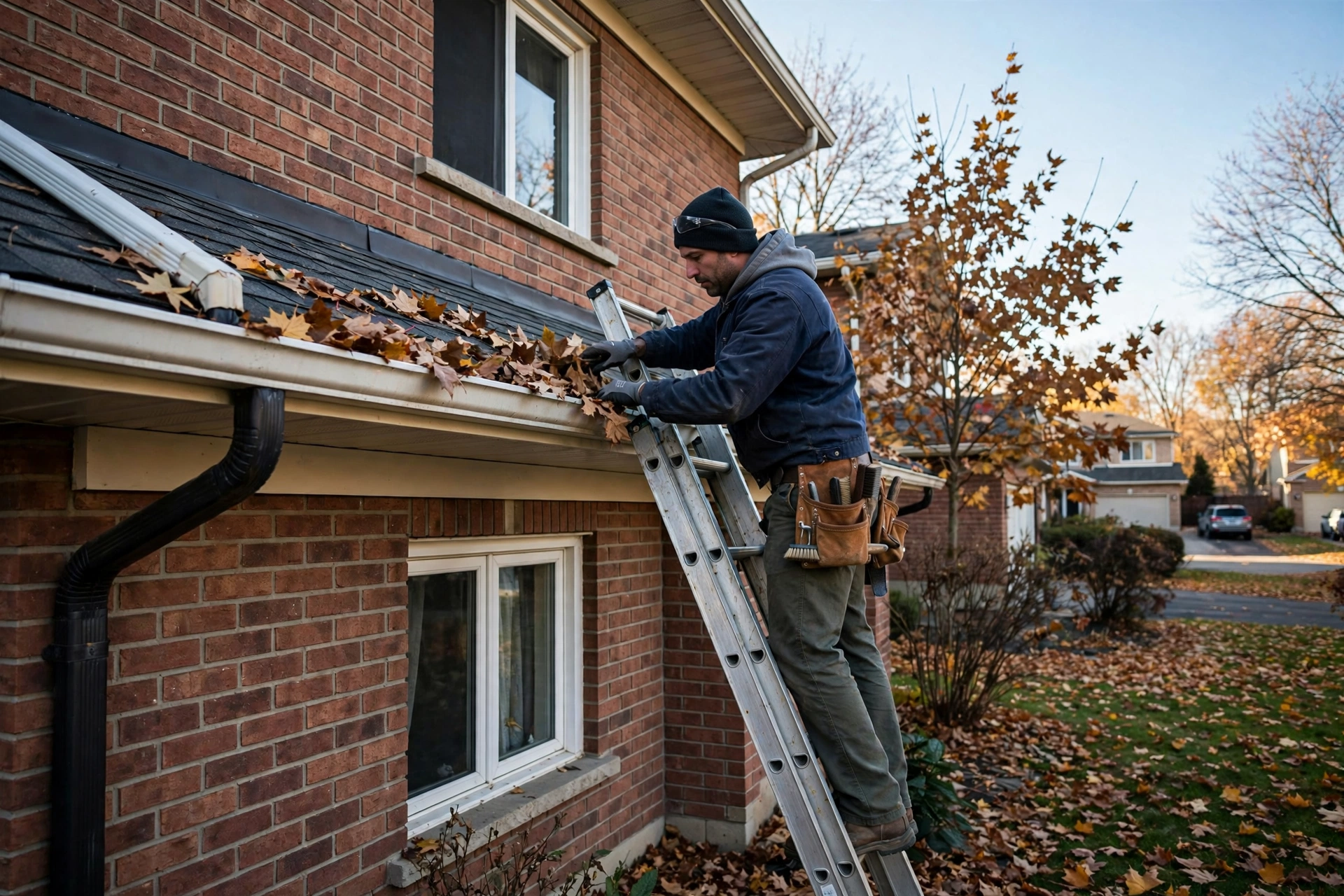

Every Mississauga home has one room that never quite warms up. In a Meadowvale or Erin Mills house it is often the front entry or the bedroom over the garage. In an older Streetsville or Port Credit home it can be the whole main floor on a windy night. In a City Centre condo it is usually the spot beside the balcony door. Most of the time the furnace is not the problem — cold air is getting in through just two or three specific gaps.
The three fixes that solve almost every draft are weather stripping, a door sweep, and caulking. They are not interchangeable. Each seals a different kind of gap, and putting the wrong one in the wrong place is the most common reason a draft “fix” fails within a month. This guide is about telling them apart first.

Step One: Find the Draft Properly
Test on a cold, windy evening, when the pressure difference is strongest. A draft you can barely feel on a calm October afternoon will be obvious when a northwest wind is coming off Lake Ontario in January.
- The hand test. Wet the back of your hand and move it slowly around the edges of a closed door or window. Note exactly where you feel air — top, sides, bottom, or one corner — because the location is the diagnosis.
- The paper test. Close the door on a sheet of paper at several points around the frame. If it pulls out with almost no resistance, the seal is not compressing there. If it grips in some spots and slides in others, the gap is uneven — a fit problem, not just a worn seal.
- The light test. At night, have someone move a flashlight slowly around the frame outside while you watch from inside in the dark. Any line of light is a line where air moves freely.
Work through every exterior door, including the garage and side doors, plus windows in the coldest rooms. In 1970s to 1990s homes in Lisgar, Churchill Meadows, and Malton, the original seals are all the same age, so if one has failed, the others are rarely far behind.
If the Air Comes Around the Sides or Top of a Door: Weather Stripping
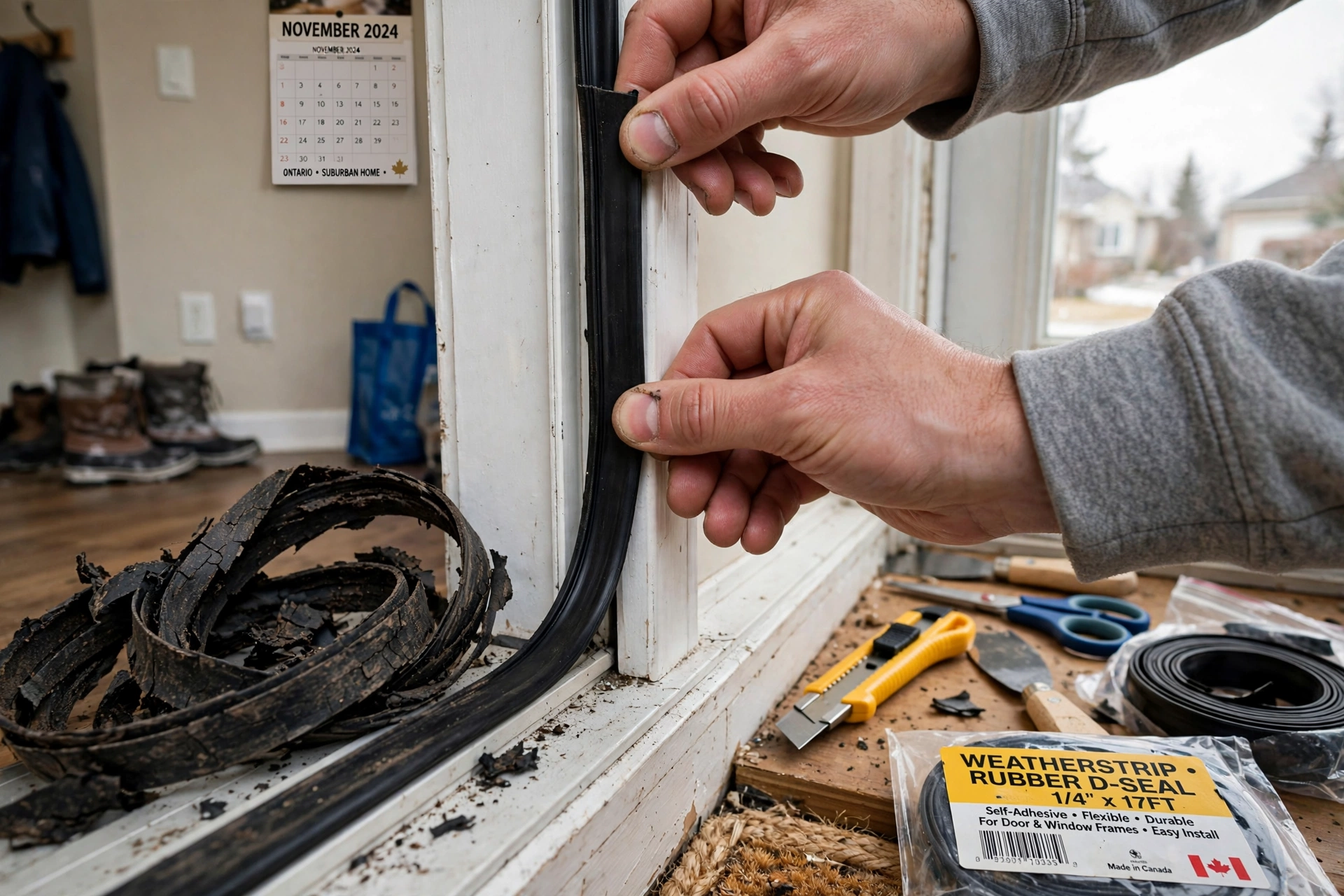
Weather stripping is the seal around the sides and top of a door frame. The door compresses against it when it closes, and that compression is what makes it airtight. After ten or fifteen Ontario winters, most stripping has flattened, hardened, cracked, or torn at the corners — and once it no longer springs back, the door is closing against bare wood or metal.
Signs weather stripping is your problem:
- You feel air along the sides or top of the door, fairly evenly.
- The existing strip looks flat, brittle, or split, or sections are missing.
- The paper test slides out easily all the way around, not just in one corner.
- You hear wind or traffic noise more clearly at the door than at a wall.
The fix is to remove the old strip completely and fit a replacement matched to the frame — kerf-in stripping for frames with a slot, screw-on profiles for frames without one. Bargain foam tape disappoints most often: it compresses within a season and peels in the cold. A properly fitted replacement, seated evenly and cut cleanly into the corners, restores the seal the door was built with.
One warning: if the paper test grips at the top but slides at the bottom corner, or the door has to be lifted to latch, new stripping alone will not hold. Sagging hinges or a shifted strike plate need correcting first — otherwise you are sealing an uneven gap with an even seal. That combination, fitting the door then sealing it, is what weather stripping installation in Mississauga covers, and it is the difference between a draft that stays fixed and one that returns by February.
If the Air Comes Under the Door: A Door Sweep
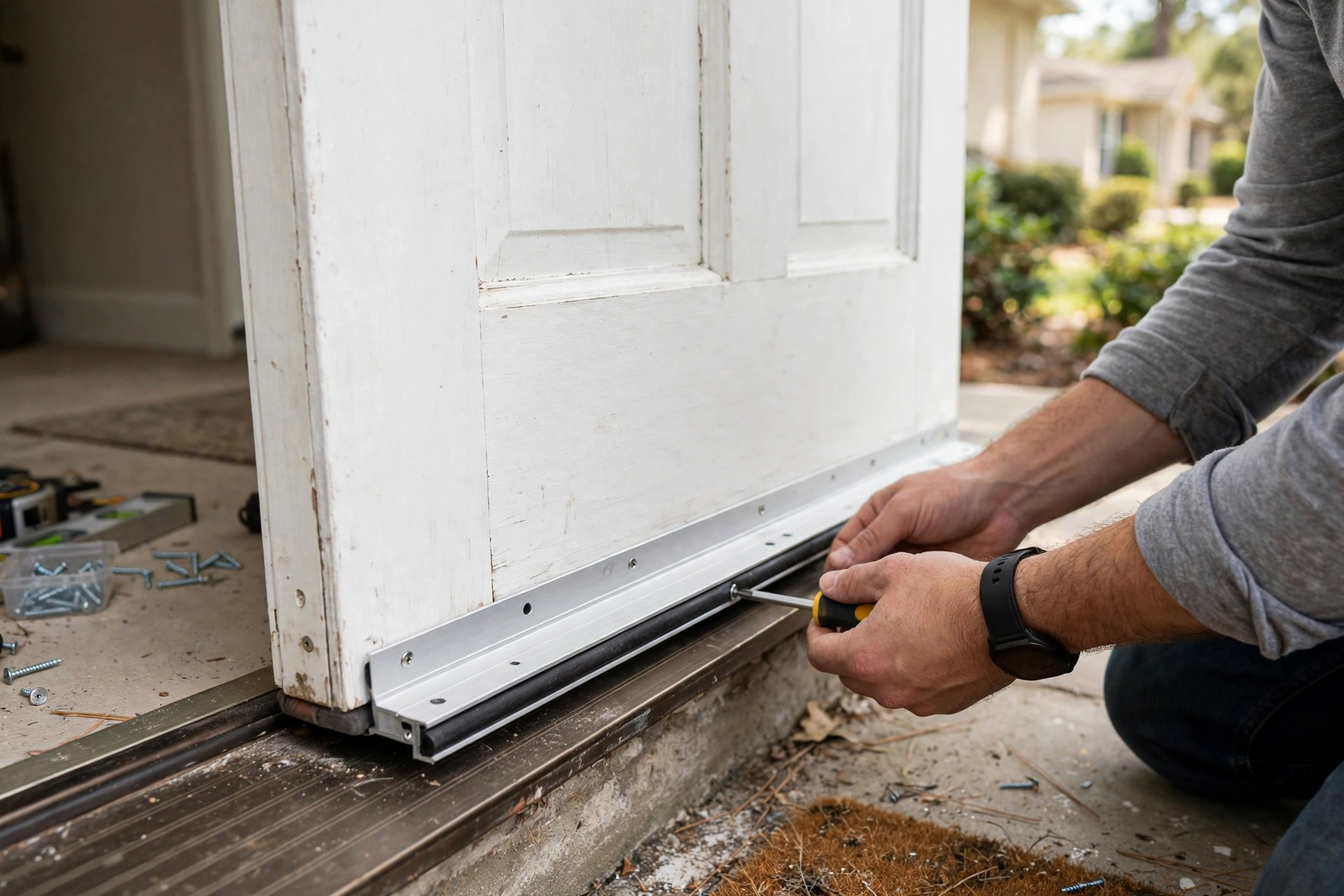
The bottom of a door is a separate problem with a separate part — weather stripping does not seal it. A door sweep, fitted along the bottom edge of the door itself, closes the gap between door and threshold. When it wears, splits, or was never fitted at all (common on garage entry doors and older back doors), you get a direct horizontal slot for cold air, meltwater, snow dust, and pests.
Signs a sweep is your problem:
- The draft is strongest at floor level, and the entry floor is cold.
- You can see daylight under the door, or snow dusts in after a storm.
- The existing sweep is cracked, dragging, or loose, or the threshold is worn on one side.
Fitting a sweep means sizing it to the full width, setting the seal to just brush the threshold along its whole length, and confirming the door still moves freely over entry mats. Too high and it seals nothing; too low and it drags and tears — which is why poorly fitted sweeps get removed and the draft returns.
Pay special attention to the door between house and attached garage, common across Erin Mills, Lisgar, and Cooksville. That door needs a sound sweep and a working self-closing fit for more than comfort: it is part of the barrier that keeps garage fumes out of the house.
If the Air Comes Around a Window Frame or a Fixed Joint: Caulking
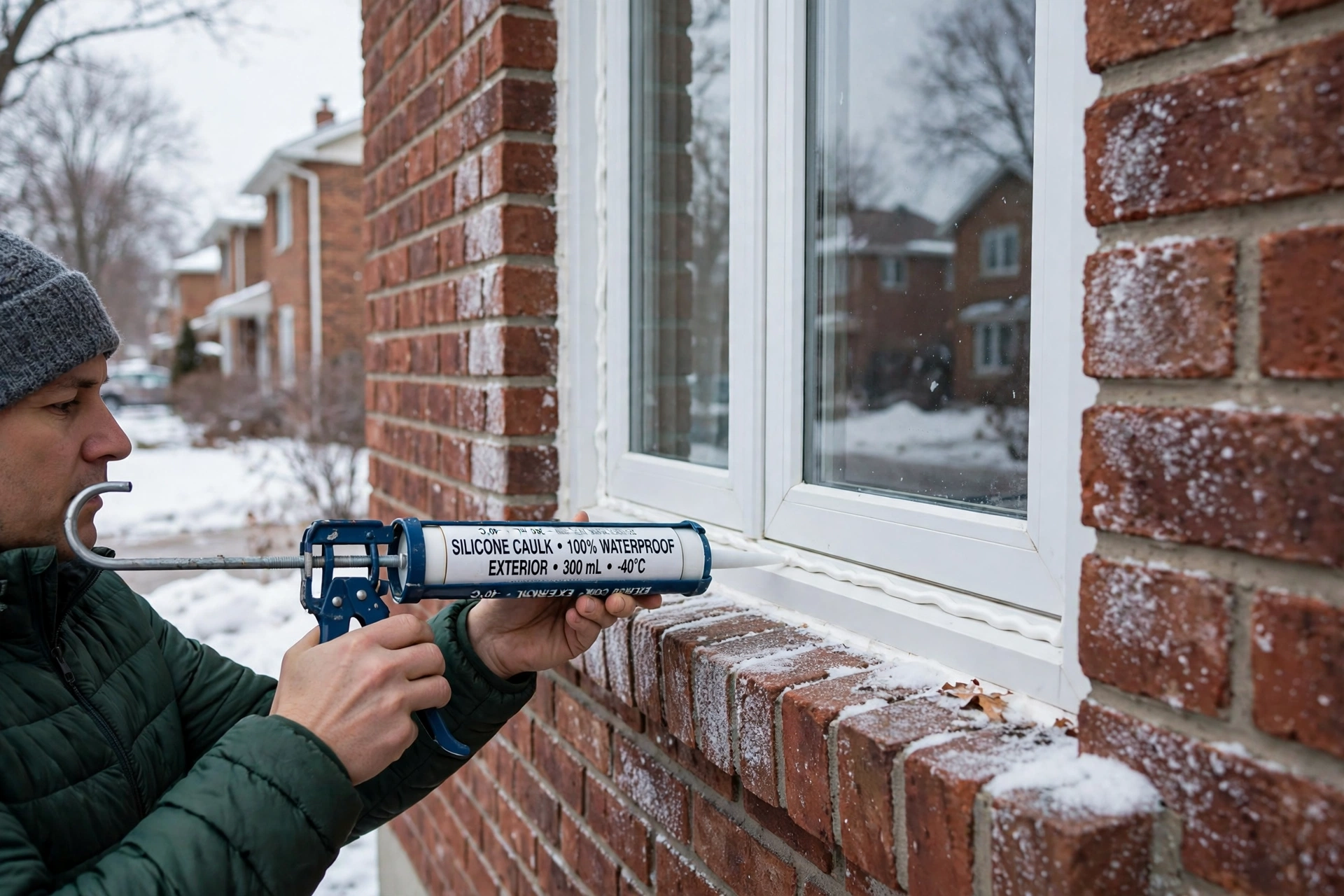
Caulking seals gaps that do not move — the joint between a window frame and the wall, brick-to-frame transitions outside, trim joints, and seams around vents and pipes. If air is coming around the frame itself rather than through the sash, failed caulking is almost always the cause.
Signs caulking is your problem:
- The draft follows the outline of the frame, not the opening sash.
- The existing sealant is cracked, shrunk back from one side of the joint, or missing in sections.
- Inside, you see peeling paint or cold patches on the wall immediately around the frame.
Good caulking work is mostly removal and preparation. Old sealant has to come fully out, the joint must be clean and dry, and the new bead has to be the right product for the location — exterior-grade outside, paintable at interior trim, mould-resistant in bathrooms. A new bead smeared over cracked old caulk fails in the same spot within a season, because it bonds to the failing material instead of the joint.
Timing matters in Mississauga. Most exterior sealants need temperatures above roughly 5°C to cure, so exterior window joints are a fall job, not a mid-January one. Interior sealing can be done any time. Where several windows have failed at once — typical in Cooksville and Meadowvale homes where everything was sealed in the same year — caulking services in Mississauga bundle the whole list into one visit.
A note on the sash: if air comes between the sashes of an older double-hung window, that is a weather seal problem, not caulking. Sealing a moving joint shut trades a draft for a window that no longer opens.
When the Real Problem Is the Door or Frame Itself
Sometimes none of the three seals is the root cause. If a door sticks in summer and gaps in winter, if one corner shows light while the opposite binds, or if a frame has rotted at the bottom, the opening has moved. The order of work matters: adjust the frame and door first — hinge and strike work, planing a binding edge, replacing rotted trim — then seal. Small carpentry repairs in Mississauga like these are what make the sealing last.
What Changes by Home Type
1970s–1990s subdivisions (Meadowvale, Erin Mills, Lisgar, Malton): Expect all three fixes on the same house — original stripping, sweeps, and window caulk age out together, and the bedroom-over-garage layout makes drafts especially noticeable.
Older village homes (Streetsville, Port Credit, Lorne Park): Expect frame and fit issues alongside worn seals. Test carefully — the gap is rarely uniform on an original wood door.
Newer homes (Churchill Meadows, newer infill): Expect settlement gaps. After a few freeze-thaw cycles, caulking splits at frame joints and doors shift slightly; the seals are young, the joints have moved.
Condos (City Centre, Square One area, Cooksville high-rises): The usual culprits are balcony door seals and the gap under the suite entry door. Check building rules before changing anything on the corridor side of your entry door — many buildings control that door — but balcony seals and interior thresholds are generally the owner’s to maintain.
What Affects the Cost of Fixing Drafts
Peter’s pricing is his own, so there are no figures here — but these factors shape any quote:
- How many openings. One front door is a small job; every exterior door and a dozen window frames is larger. Bundling them into one visit is usually more efficient.
- Which parts are needed. Stripping, a sweep, or caulking alone is straightforward. A door that also needs hinge, strike, or frame repair adds fitting work first.
- Access and height. Ground-floor windows are simple; second-storey exterior caulking needs ladder work and the right weather window.
- Condition underneath. Sealant hiding rotted wood or water damage takes longer, because the repair has to fix the cause, not just cover it.
A One-Evening Draft Audit You Can Do Tonight
Wait for a windy evening, then spend twenty minutes: hand-test every exterior door and note where the air comes in — sides, top, bottom, or corner. Paper-test the front and garage doors. Light-test the worst door after dark. Run a hand around the window frames in your coldest room. Write it down by location. That list — “front door, bottom; kitchen window, left frame joint; garage door, all around” — turns a vague “my house is drafty” into a single, targeted repair visit.
Do the audit soon. In Mississauga the sealing season narrows fast once overnight temperatures stay below freezing.
Ready to Stop the Drafts in Your Mississauga Home?
If you have found where the cold air is getting in — or you would rather have it found and fixed in one visit — Peter can help. Call Peter at 647-699-3193 or send a message through the contact page to book your draft repairs before the deep freeze sets in.